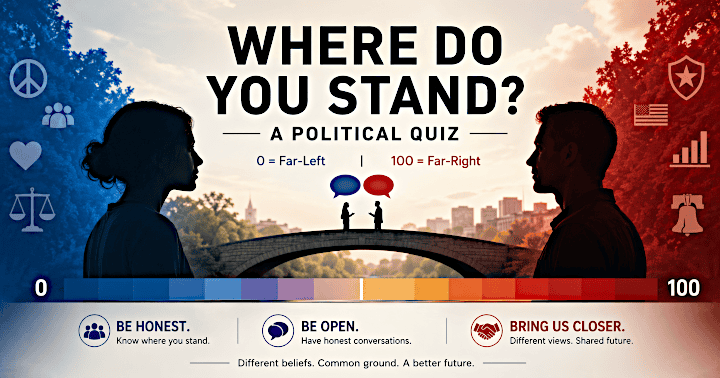
I was wondering… where do I stand politically? — really stand, not just where I assume I do. That question started as a simple curiosity for me, and it turned into something much bigger.
I took a quiz just like the one below, and my results surprised me. From there, I found myself asking which presidential candidates actually match my values, where Donald Trump fits on the spectrum, and what all the different political categories even mean. Eventually, the conversation led somewhere I didn’t expect: a deep look at why America is so bitterly divided, how it got this way, and what research tells us we can actually do about it.
All of that is in this post. But it starts with you being honest with yourself — setting aside your political default and discovering where you genuinely stand. Because here’s what I believe: most of us are closer to each other than we think, and that gap we keep widening may be the most important thing our generation needs to close.
Where Do I Stand Politically? - The Quiz
Answer 13 straightforward questions in plain everyday language — no policy jargon, no trick questions. Find out where you stand politically and which current potential 2028 presidential candidates align best with your views.
There are no wrong answers.
The Scale — 7 Broad Categories
Now that you know your score, here are the political categories with score ranges, descriptions of each category, along with examples of current politicians in each category, and their estimated scores:
0–15: Far Left: Believes the government should control major parts of the economy, dramatically redistribute wealth, defund or fundamentally restructure police, open borders, and pursue radical social transformation. Very few mainstream American politicians sit here. Examples: Bernie Sanders (~10), AOC (~12)
16–30: Progressive: Strong government role in healthcare, housing, and education. High taxes on the wealthy. Significant police reform. Very liberal on social issues. Skeptical of military spending. Examples: Elizabeth Warren (~20), Cory Booker (~24), Gavin Newsom (~18)
31–45: Center-Left / Moderate Democrat: Believes government should help people but pragmatically, not radically. Supports a public healthcare option, sensible gun rules, climate action, and welcoming immigration — but wants things to actually work, not just sound good. Examples: John Hickenlooper (~40), Pete Buttigieg (~40), Josh Shapiro (~42), Gretchen Whitmer (~40), Michael Bennet (~42), Jared Polis (~44)
46–55: True Independent / Dead Center: Genuinely split down the middle. Might support lower taxes AND a public healthcare option. Hard to predict. Often frustrated by both parties. Examples: John Fetterman (~46), Joe Manchin (~52), Kyrsten Sinema (~54)
56–70: Center-Right / Moderate Republican: Believes in lower taxes, less regulation, strong military, and traditional values — but isn’t extreme about it. Accepts some government safety nets. Getting rarer in today’s Republican Party. Examples: Nikki Haley (~60), Mitt Romney (~58), Larry Hogan (~57), Marco Rubio (~68)
71–85: Conservative Republican: Strongly limited government, low taxes, strict immigration, traditional social values, strong law enforcement. Aligns closely with mainstream Trump-era Republican positions. Examples: Ron DeSantis (~73), JD Vance (~76), John Kennedy-LA (~76)
86–100: Far Right: Nationalist, authoritarian-leaning, anti-immigration, deeply religious in policy, hostile to most government programs except military. Conspiracy-adjacent in some cases. Examples: Matt Gaetz (~84), Marjorie Taylor Greene (~88)
Where Does Trump Land?
Trump sits around 80–86 depending on the issue — straddling the line between Conservative Republican and Far Right. He’s not purely ideological, but his overall governing style and positions land him firmly at the upper end of the Conservative Republican range and into Far Right territory on several issues.
Disclaimer: The scores assigned to politicians here are estimates based on their public positions and voting records, not official measurements. Reasonable people may place them somewhat differently.
Political Division in the US
Most of us are aware of how politically divided the United States currently is. The term “one nation” in the Pledge of Allegiance leaves much to be desired. I wondered how and why we have become so divided.
Where Did It Start?
The division didn’t start overnight. Most researchers trace the serious acceleration to the 1990s, with a few key turning points:
- Newt Gingrich’s “Contract with America” (1994) introduced a more aggressive, win-at-all-costs style of politics that changed the tone in Washington.
- The 2000 election (Bush vs. Gore, decided by the Supreme Court) deeply damaged trust.
- 9/11 and the Iraq War split the country sharply.
- The Obama years (2009–2016) saw the rise of the Tea Party on the right and a hardening of partisan identities on both sides.
- Social media’s explosion (roughly 2008–2016) poured fuel on everything.
- Trump’s 2016 election turbocharged it further — and it’s been accelerating since.
Is One Side Moving More Than the Other?
This is the most honest answer research gives us: both sides have moved, but not equally.
The percentage of Americans identifying as moderate has dropped from 43% in 1992 to 34% in 2024. Meanwhile, the share identifying as liberal rose from 17% in 1992 to 25% by 2016. In 2024, the shares of Republicans identifying as conservative and Democrats identifying as liberal both reached record highs. [Source]
So the left grew significantly from the 1990s through around 2016, then leveled off. The right has become more intensely conservative within the Republican Party, even if the overall percentage calling themselves conservative hasn’t changed much.
Here’s the key nuance: research suggests Americans are less polarized than they think, and that there is significant ideological overlap on many policies. Polarization is felt most strongly among those who are the most politically engaged. However, Americans are very emotionally polarized — they simply don’t like members of the other party. [Source]
In other words, the fighting is worse than the disagreement itself — which is somewhat hopeful.
What’s Driving The Division?
Several forces are working together to divide us:
- The media business model: Most digital media relies on attention metrics like clicks. Because competition for public attention is so intense, media outlets face strong economic incentives to publish and promote the most attention-grabbing — often the most outrageous — content. [Source] Calm and reasonable doesn’t get clicks. Outrage does.
- Social media sorting: Over half of U.S. adults get their news from social media at least occasionally. [Source] And those platforms are increasingly split along party lines — Republicans on X and Truth Social, Democrats on Threads and Bluesky. People are living in completely different information worlds.
- The way we vote: Our current system — where you just pick one candidate and the one with the most votes wins — actually rewards extreme candidates. In a primary election with a small, fired-up voter base, you can win by appealing only to your most passionate supporters. You don’t need the middle at all.
- Mutual delegitimization: Both parties are systematically and intentionally undermining each other’s legitimacy — not just disagreeing on policy, but questioning whether the other side has any right to govern at all. [Source] That’s a dangerous shift from normal political disagreement.
- The anger is real on both sides — but different: Democrats’ anger at the federal government is currently the highest recorded by either party since 1997. Republican anger peaked during the Obama and Biden years. Right now, Republicans report the highest contentment since George W. Bush’s first term. [Source] So the anger flips depending on who’s in power — it’s not one side being uniquely angry, it’s a cycle.
How Do We Fix It?
Researchers have identified several approaches, ranging from practical to longer-term structural changes:
- Change how we vote — Ranked-Choice Voting (RCV): This is probably the most-studied structural fix. Instead of just picking one candidate, you rank them as your 1st, 2nd, and 3rd choices. If nobody gets a majority, the last-place candidate is eliminated, and those votes transfer to second choices — until someone wins a majority.
Why does this help? Our current system lets candidates win with a small percentage of votes, especially in primaries, by expressing extreme views. RCV reduces this by requiring candidates to appeal to a broader base and by moderating their rhetoric and policies. [Source]
Research shows RCV increases voter turnout, decreases negative campaigning, and can lead to the election of candidates with a broader base of support, including more moderate candidates. [Source]
The honest caveat: the effects so far have been real but modest. It’s not a magic fix. - Strengthen local news and local politics: Research shows local news is less politically polarizing and more trusted than national news. Local governments are in a unique position to cooperate and compromise across party lines — the negative effects of polarization are less evident at the local level. [Source]
- End gerrymandering: When politicians draw their own district lines, they create “safe” districts where they only need to appeal to their own base — which rewards extremism. Independent redistricting commissions (which Colorado actually uses) help fix this.
- Reduce the influence of primary elections: Primaries are where most extremism gets locked in because only the most passionate — and often most extreme — voters show up. Open primaries, where any voter can participate regardless of party, tend to produce more moderate candidates.
- Personal behavior — and this one matters: Research consistently shows that nearly two-thirds of consistent conservatives and about half of consistent liberals say most of their close friends share their political views. [Source] When we only talk to people who agree with us, our views get more extreme and our fear of “the other side” grows. Simply having genuine friendships across political lines — which is harder than it sounds — is one of the most effective things an individual can do.
The Bottom Line
The division is real, serious, and getting worse — but it’s not hopeless. Most Americans actually agree on more than the loudest voices suggest. The system itself — how we vote, how media makes money, how districts are drawn — is rewarding extreme behavior. Fix the system, and the behavior changes. That’s the core insight from most serious researchers on the political division of Americans.
What do you think? Can we meet each other in the middle and become one nation again?
A Note on Methodology and Neutrality
This quiz was not designed to meet formal political science standards — it wasn’t built in a university lab or validated through peer review. It was built to be simple, honest, and accessible to everyday people who want a clearer sense of where they stand. That said, genuine effort was made to ensure the questions cover a broad and representative range of issues, that the answer options reflect a real and consistent range of political positions, and that the scoring produces results that are reasonable and fair.
Every effort was also made to present this content without favoring any political side. The quiz, the category descriptions, the analysis of political division, and the placement of politicians on the scale were all approached with the goal of being factually grounded and evenhanded. Reasonable people may score or place things somewhat differently — and that’s okay. Politics is not an exact science, and this post makes no claim that it is.
If your results surprised you, that’s probably the most valuable outcome of all.