Back to: Neuropsychology & Behavior
Introduction
Picture this: you cram all night before an exam, and it works, you ace the test the next day. Two weeks later, someone asks you about the same material and you’ve got nothing. Meanwhile, a friend who spread the same amount of study time across three weeks, testing herself along the way, still remembers most of it a year later.
That gap isn’t about who’s smarter. It’s about how memory actually works, and cramming works against it.
Core Concepts
Memory isn’t a video recording sitting in storage waiting to be replayed. Every time you recall something, your brain rebuilds it from pieces, and small details can shift each time you do. This is why two people can remember the same event differently and both be sincere.
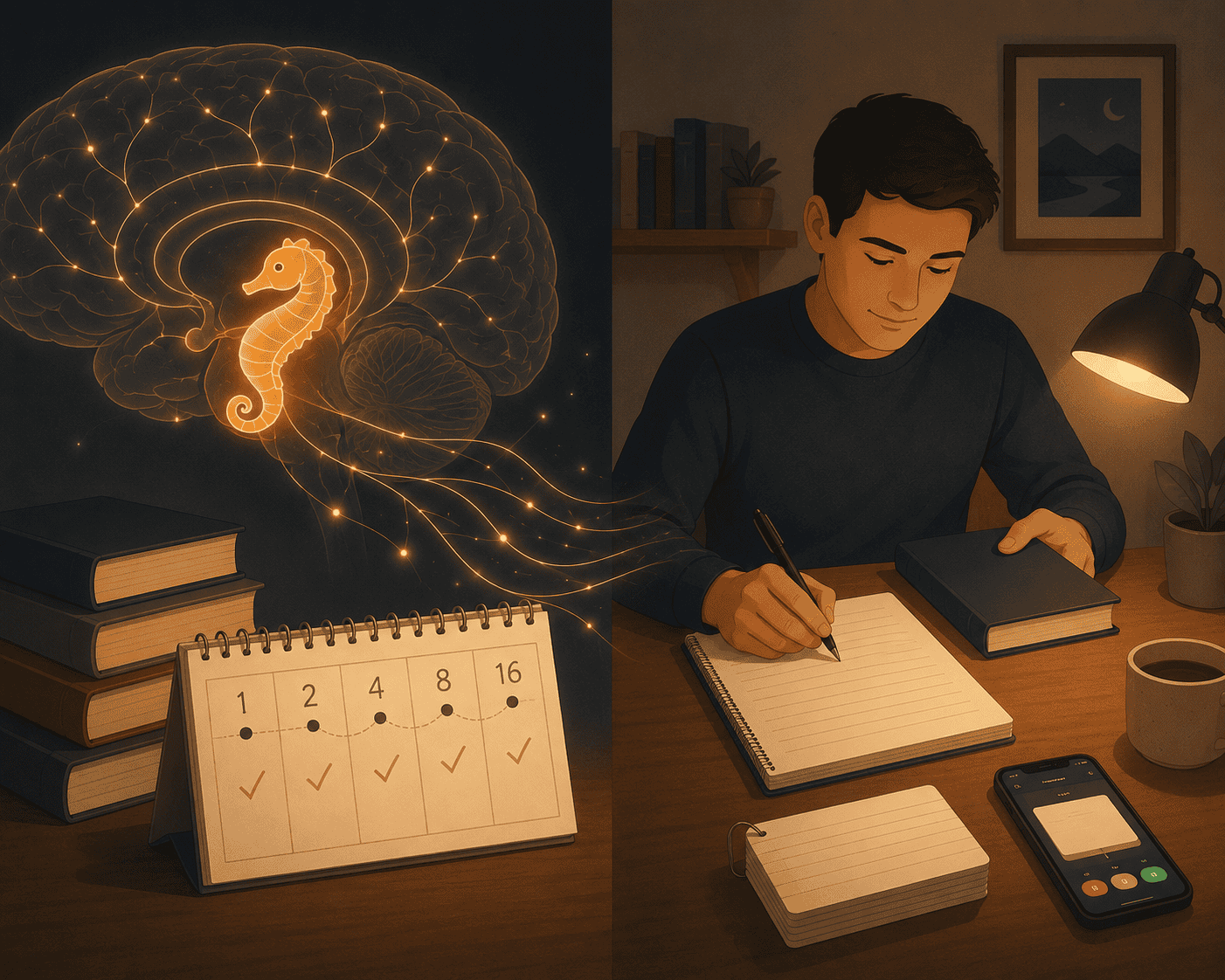
A brain structure called the hippocampus (a small, curved structure deep in the brain, named for its resemblance to a seahorse) is essential for forming new long-term memories. But it’s not where memories live permanently. Over time, memories get transferred to the outer layer of the brain, the cortex, for longer-term storage. That transfer process is called consolidation.
One of the best-established findings in learning science is spaced repetition: reviewing information at increasing intervals (say, one day, then three days, then a week) beats reviewing it all at once. This connects directly back to that cramming scenario above. Cramming skips consolidation almost entirely, so what feels like learning is really just short-term familiarity.
The Brain Science
Here’s the mechanism behind why testing yourself works better than re-reading. Every time you retrieve a memory, the physical connections involved get briefly destabilized, then re-stored. That re-storage step is where strengthening happens. Re-reading notes doesn’t trigger this retrieval process, so the connections never get that reinforcement. Actively pulling information out of your head, even if you get it wrong, does.
This also explains why sleep matters so much. Consolidation activity ramps up during sleep, especially the night right after you learn something. Skimping on sleep after studying undercuts the process before it can finish.
What Actually Helps
(Strong evidence)
Active recall, meaning testing yourself instead of just re-reading or highlighting, beats passive review by a wide margin. This is one of the most consistently replicated findings in learning research. Flashcards, practice questions, or simply closing the book and writing down what you remember all count.
Spaced repetition beats cramming for anything you want to remember long-term, even though cramming feels more effective in the moment. Feeling confident right before a test and actually retaining the material a month later are two different things.
Sleep the night after learning something plays a direct role in locking it in. This is well-established, not a wellness talking point.
A Study Plan You Can Use
Built directly on the evidence above: active recall and spaced repetition, done consistently, with sleep protecting the gains.
A sample weekly plan (for any subject)
Day 1: First exposure. Read or watch the material once. Don’t take detailed notes yet, just get familiar with it.
Day 1, later that evening: Close the material and write down everything you remember, in your own words, without looking. Then check what you missed. This first retrieval attempt is rough, and that’s fine, the struggle is part of what makes it work.
Day 2: Test yourself again from memory. Fill in gaps from the source material only after you’ve tried recalling.
Day 4: Test yourself again (a slightly longer gap).
Day 8: Test yourself again (longer gap still).
Day 16: Test yourself again.
That expanding gap is the spacing part. Each successful recall means you can wait longer before the next review; each failed recall means you shrink the interval back down.
A few rules that make this work in practice: study before sleep when you can, since consolidation leans heavily on the night right after learning. Keep review sessions short, ten to twenty minutes of active recall beats an hour of re-reading. And resist the urge to switch back to just re-reading when recall feels hard, that difficulty is the mechanism, not a sign you’re doing it wrong.
Tools that automate this
Anki is the standard tool for this. It’s a free flashcard app that runs a spaced repetition algorithm for you, it schedules each card’s next review based on how well you remembered it last time, so you don’t have to manually track intervals like Day 1, 2, 4, 8 above. It works for any subject and has a steep-ish learning curve but a huge user base and prebuilt decks for many topics.
RemNote and Quizlet are lighter-weight alternatives with similar spaced repetition features, generally easier to start with, though Anki’s algorithm is the most studied and refined of the bunch.
If you’d rather not use software, plain paper flashcards with a simple box system (cards you get right move to a box reviewed less often, cards you miss move back to daily review) accomplish the same thing. The mechanism matters more than the tool.
One caution: these tools work great for facts, definitions, and vocabulary. For material that requires deeper understanding (like the “why” behind concepts in this course), pair flashcards with writing out explanations in your own words, since that also uses active recall but tests comprehension rather than just memorization.
Summary
Memory is rebuilt each time you recall it, not replayed like a recording, and it moves from the hippocampus to the cortex through a process called consolidation. If you want something to stick, test yourself instead of re-reading, spread your study sessions out instead of cramming, and don’t shortchange sleep afterward.